
You can lift a gambling restriction (hasartmängukeeld, often called a casino ban or self-exclusion) only once the period you picked when setting it has passed. Before that date it cannot be changed or cancelled, even if you have since changed your mind. A second rule surprises many people: when the period ends, the ban stays. You have to file a separate application, and through e-MTA the restriction is deleted by the next day at the latest.
Read on if your ban is near its end date, or past it. We explain how to remove a gambling ban in Estonia through e-MTA or a service bureau, how removal works for a single game type, and why playing on a foreign site during the ban is a bad idea, plus a few questions to answer before applying. If you want a refresher on how the ban is registered, see how to request a casino ban in Estonia.
When you can remove the gambling ban
The official Estonian name is hasartmängu mängimise piirang, while everyday speech prefers gambling ban or casino ban. The register belongs to the Estonian Tax and Customs Board (EMTA). The restriction has no end date of its own, but when setting it you choose a period of 6 to 36 months. Within that period it cannot be shortened, changed or cancelled, whatever the reason.
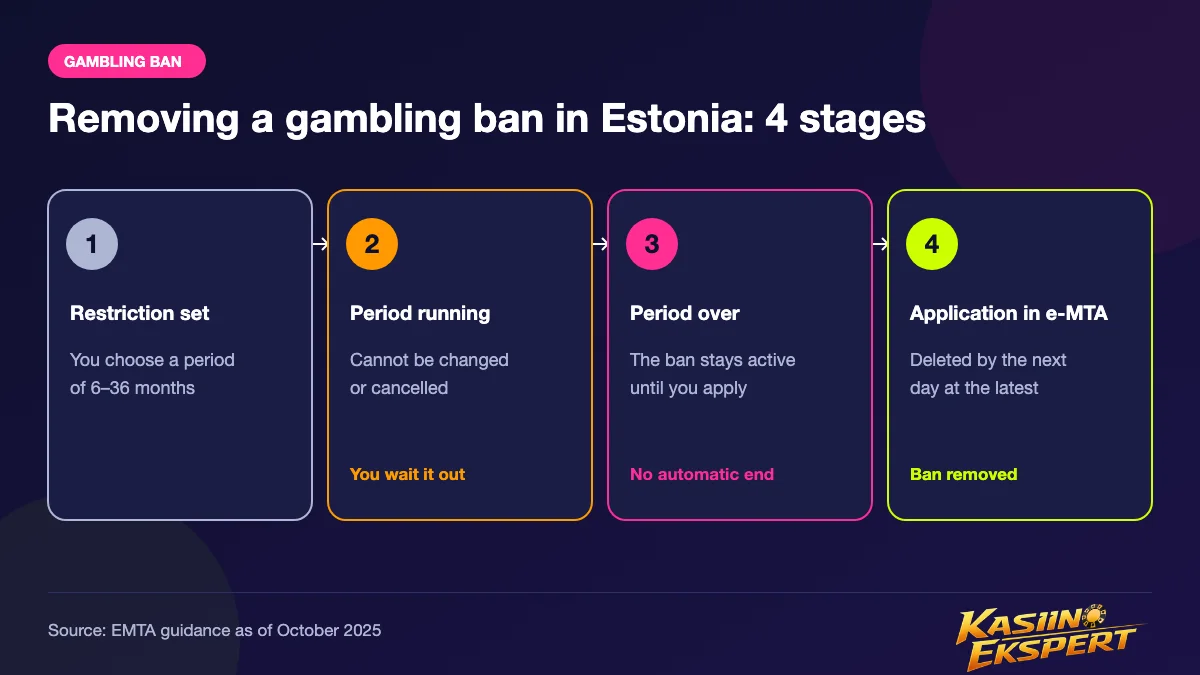
The chosen period therefore marks the earliest day on which you may ask for deletion. If that date has passed and nothing has been filed, the restriction stays in force until you request its removal. Many expect it to lapse like a trial subscription and learn otherwise on a casino login screen. Under EMTA guidance as of October 2025, ending the restriction always takes a separate application.
What the ban does to your accounts and balances while it runs is explained in our article on how a casino ban in Estonia affects players. The table below shows your current stage and the next step.
| Your situation | What applies | What you can do |
|---|---|---|
| The chosen period is still running | The restriction is active and cannot be changed or cancelled | Wait for the period to end and put the date in your calendar |
| The period is over, no application filed | The restriction stays active and casinos will not let you play | File a deletion application if you are sure of your decision |
| Application filed in e-MTA | The restriction is deleted by the next day at the latest | Until then the restriction still applies in full |
| Application filed at a service bureau | The restriction is deleted by the second working day after the application at the latest | Allow for weekends and public holidays |
Lifting the casino ban in e-MTA
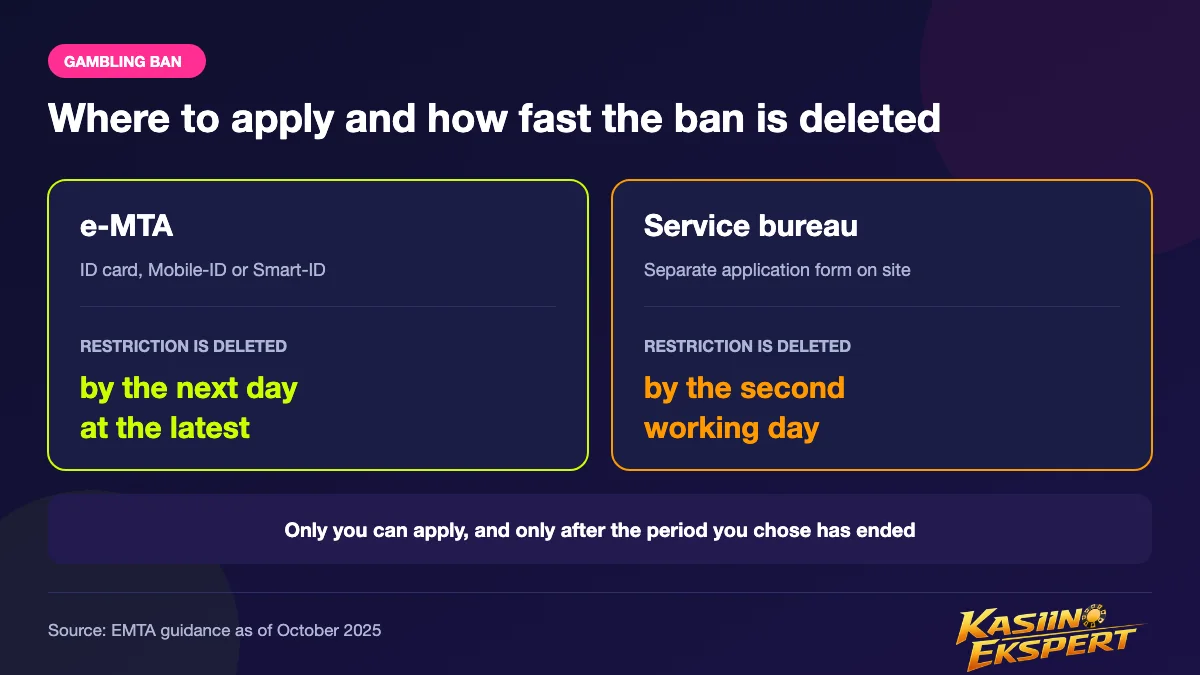
The fastest route is the e-MTA self-service portal, which needs a digital identity to log in: Smart-ID, an ID card or Mobile-ID. You can only apply in your own name, since nobody can delete a restriction for another person. An unsigned email does not count as an application.
- Look up the date your chosen period ends. If that day has not arrived, you cannot apply yet.
- Sign in to e-MTA using an ID card with a card reader, Mobile-ID or Smart-ID.
- Open the gambling restriction section. If the menu has changed and you cannot find it, open EMTA's guide to registering a gambling restriction on its website.
- Choose the application to delete the restriction and check that it shows your details and the correct restriction.
- Confirm the application with the PIN code of your ID tool.
- Wait for the deletion. The restriction leaves the register by the next day at the latest, and only then will Estonian-licensed casinos let you play again.
Applying at a service bureau
You can also hand in the deletion application at an EMTA service bureau. Bring an identity document, since only the person concerned can apply there too. After an application made there, the restriction is deleted by the second working day at the latest. An application handed in on a Friday may therefore only take effect early the following week.
Removing the ban for one game type
When a restriction is set, each game type is chosen separately. The options are games of chance and games of skill (casino, poker and tournaments, online play included), toto or sports betting, and classic lottery. Instant lotteries such as scratch cards cannot be restricted at all. If you restricted more than one type, each appears as a separate entry in the register.
That way you can judge each type on its own. If the trouble started with online casino play, keeping the sports betting restriction changes little for you, and vice versa. A sensible choice is to keep the restriction covering the game you find most risky. Whether one application can target a single type is worth checking in EMTA's guide, or with EMTA directly, before you file.
Playing with a casino ban: why it backfires
While the restriction is active, no operator with an Estonian licence may let you play. Licensed casinos check the register, so one entry covers all of them at once. You can see which brands those are on our page of Estonian casinos with an EMTA licence. Pleading with one operator's support team will not help, since the casino has no say in the matter.
Foreign sites without an EMTA licence do not look at the Estonian register, so playing there switches off your own protection exactly when it would do the most good. You also leave Estonian supervision behind. If a payout never arrives or an account is closed, EMTA cannot help, and any dispute runs under foreign law, often in another language. We look at those risks more closely in the safety of foreign casinos for Estonian players.
If you notice an urge to look for sites that cannot see the ban, that urge is itself a sign that removing the restriction can wait. When you do return to playing later, confirm before you register that the site holds an Estonian licence. Our walkthrough on verifying a casino's licence shows you where to look.
Questions to ask before you apply
Removing the restriction is your call to make. Because an e-MTA application clears the entry by the next day, take a few minutes before confirming to answer these honestly.
- Why did I set the restriction back then, and has that reason really gone away?
- Do I want to start playing again to win back money I lost in the past?
- Do I have loans or unpaid bills that this money is actually needed for?
- Can I name a monthly amount I could lose without it bothering me, and can I stick to it?
- Do the people close to me know I plan to gamble again?
If any answer makes you uneasy, there is no rush. The ban stays in force after its period ends, so you can still apply a month or a year from now.
Gentler options in between
If you delete the restriction, you can replace it with protection you manage yourself. Casinos with an Estonian licence usually let you set deposit, loss and time limits in a few minutes. Paf, for example, lets players define loss limits, and Trickz offers tools for fixing personal play limits. Operators with a long track record are gathered on our trusted casinos page.
Your bank can add a second layer, as some banks let you block card payments to gambling sites. Ask your bank whether it offers this and how the setting is changed later. A bank block works even where a site ignores the register. Set limits before the first deposit, as decisions made after a loss are seldom calm.
A plan for the first month
The first weeks after a long break are the most sensitive. A few agreements with yourself help:
- Pick one casino and avoid opening accounts at several sites at once.
- Fix a deposit limit ahead of the first payment and leave it untouched for the whole first month.
- Skip bonuses during the first month, since a wagering requirement keeps you playing longer than you intended.
- Mark a date at the end of the month to review your deposits and losses honestly.
Example: a 12-month ban runs out
Martin set a restriction in e-MTA for games of chance and games of skill and chose a period of 12 months. It took effect the following day. He could not shorten it, although after six months he felt in control.
When the 12 months were up, Martin tried his old casino account and still could not play: the end of the period does not erase the register entry. After going through the questions above, he decided to play again on a fixed monthly budget.
Martin filed the deletion application in e-MTA on a Monday evening, and by Tuesday at the latest the restriction was gone from the register. At a service bureau the same Monday, it could have taken until Wednesday. Before his first deposit he set a monthly deposit limit of €100 and promised himself that if he wanted to exceed it twice in a row, he would set the restriction again.
What to consider in 2026
The deletion procedure described here follows EMTA guidance as of October 2025, so check the EMTA website for changes before applying. Deletion restores access to operators licensed in Estonia. Winnings from an operator outside the EEA may create an income tax obligation, so clarify your own case with EMTA if unsure.
A new restriction is just as simple to set. In e-MTA it applies by the next day at the latest; a form completed with an identity document at a service bureau or gaming venue takes effect within two working days. Knowing protection can return within a day makes deletion an easier choice for many.
Where to get free advice
If you are unsure whether removal is wise, talk it over with someone before filing. Hasartmängusõltuvuse Nõustamiskeskus, Estonia's counselling centre for gambling addiction, advises players and their families free of charge. You can reach it online at 15410.ee or by phone on 15410. A counsellor can also help you choose a budget and limits if you decide to play again. Other sources of support are listed in our overview of gambling addiction help in Estonia.
Gambling stays entertainment only while you play with money whose loss would not affect your daily life, and with a session length decided in advance. If you start chasing losses or keeping your gambling secret from family, set the restriction again through e-MTA. More on keeping play balanced is in our piece on responsible gambling in Estonia.
Frequently Asked Questions
How do I remove a gambling ban in Estonia?
Once the period you chose when setting the restriction is over, log in to e-MTA with a digital ID and file an application to delete the gambling restriction. You can also visit an EMTA service bureau with an identity document. Only you can apply for your own restriction, and EMTA does not accept an unsigned email. Check the end date of your period before you start.
Can I cancel self-exclusion in Estonia before the period ends?
No. When the restriction is set you choose a period of 6 to 36 months, and during that time it cannot be changed or cancelled. The rule is there to protect you from snap decisions made after a loss or on a bad day. Note the end date in your calendar and decide calmly once it arrives whether you want to apply for deletion.
Does the casino ban in Estonia end automatically when the period is over?
It does not. The restriction has no end date, and the period you chose only marks the earliest moment it can be deleted. If you never apply, the ban stays in force and casinos with an Estonian licence will keep refusing to let you play, even years later. Removal from the register always needs a separate application in e-MTA or at a service bureau.
How quickly can I lift a casino ban after applying?
That depends on where you apply. With an application in e-MTA, the restriction is deleted by the next day at the latest. At a service bureau it is deleted by the second working day after you apply, so weekends and public holidays lengthen the wait. Until the deletion goes through, the restriction continues to apply in full.
Is playing at a foreign casino with a casino ban a good idea?
It is a bad idea. Foreign sites without an EMTA licence do not check the Estonian register, so the protection you set for yourself does not work there. You are also outside Estonian supervision and cannot turn to EMTA if a dispute arises. If the pull towards such sites is strong, speak to a counsellor on 15410 before taking any further step.
Can someone else remove my gambling ban for me?
No. The deletion application is always filed by the person whose restriction it is. In e-MTA you confirm it with your own ID tool, and at a service bureau you need to bring an identity document. A relative or friend can support you and help you think the decision through, but they cannot submit the application in your place.
Top Casinos
 LyraBet
 HappySpins
 Hillo
 Posido
 Coolbet
Popular Categories
Related articles